The global kitchen cart market is valued at USD 1.95 billion in 2026 and growing at 6.3% annually - driven by urbanization, shrinking kitchen footprints, and a consumer base that increasingly demands flexible, multi-functional storage solutions.
For wholesalers and distributors, the growth opportunity is clear. But building a kitchen storage cart range that actually performs at the retail level requires more than simply selecting the most popular SKUs. It requires understanding how different materials shape the product's positioning, target customer, price point, and retail environment - and stocking accordingly.
This guide breaks down the four primary material categories in the kitchen storage cart market, what each delivers commercially, and how to use folding versus non-folding variants to build a complete, well-structured wholesale range.
Why Material Is the Most Important Sourcing Decision
When a wholesale buyer evaluates a kitchen storage cart, the most consequential decision is not configuration or color - it is material. Material determines:
- Durability and load capacity - how much the cart can hold and for how long
- Moisture and chemical resistance - critical in a kitchen environment
- Visual positioning - which retail segment and interior aesthetic the product serves
- Price point - and therefore which customer profile the product targets
- Maintenance expectations - what end-users need to do to keep the product looking good
Getting the material mix right across your range means your retail partners can serve multiple customer segments simultaneously - from budget-conscious urban renters to design-forward homeowners investing in a long-term kitchen upgrade.
Material 1: All-Metal Carts

What it is: All-metal kitchen carts - typically constructed from powder-coated carbon steel or stainless steel frames with metal shelving - are the foundational product in this category. They are the most structurally robust option and the most commercially proven format across global wholesale markets.
Commercial profile: All-metal carts anchor the mid-to-premium end of most wholesale ranges. Their durability and load capacity make them the preferred choice for buyers who are marketing on quality and longevity - not just price. Powder-coated finishes in Matte Black, White, and Anthracite are consistently the strongest-selling colorways, reflecting the broader design direction in kitchen organization across mature markets.
Key specifications to evaluate:
- Steel gauge (thickness) - heavier gauge equals better structural rigidity and longer product life
- Coating quality - powder coating should be tested for adhesion and resistance to chipping in humid environments
- Caster quality - locking mechanism, floor protection caps, and minimum 4 cm diameter for stability
- Shelf load capacity - clearly specified per shelf, not total unit capacity only
Best for: Retailers targeting quality-conscious consumers, urban households prioritizing durability, and wholesale buyers looking for a high-volume, repeat-order anchor product.
Material 2: All-Plastic Carts
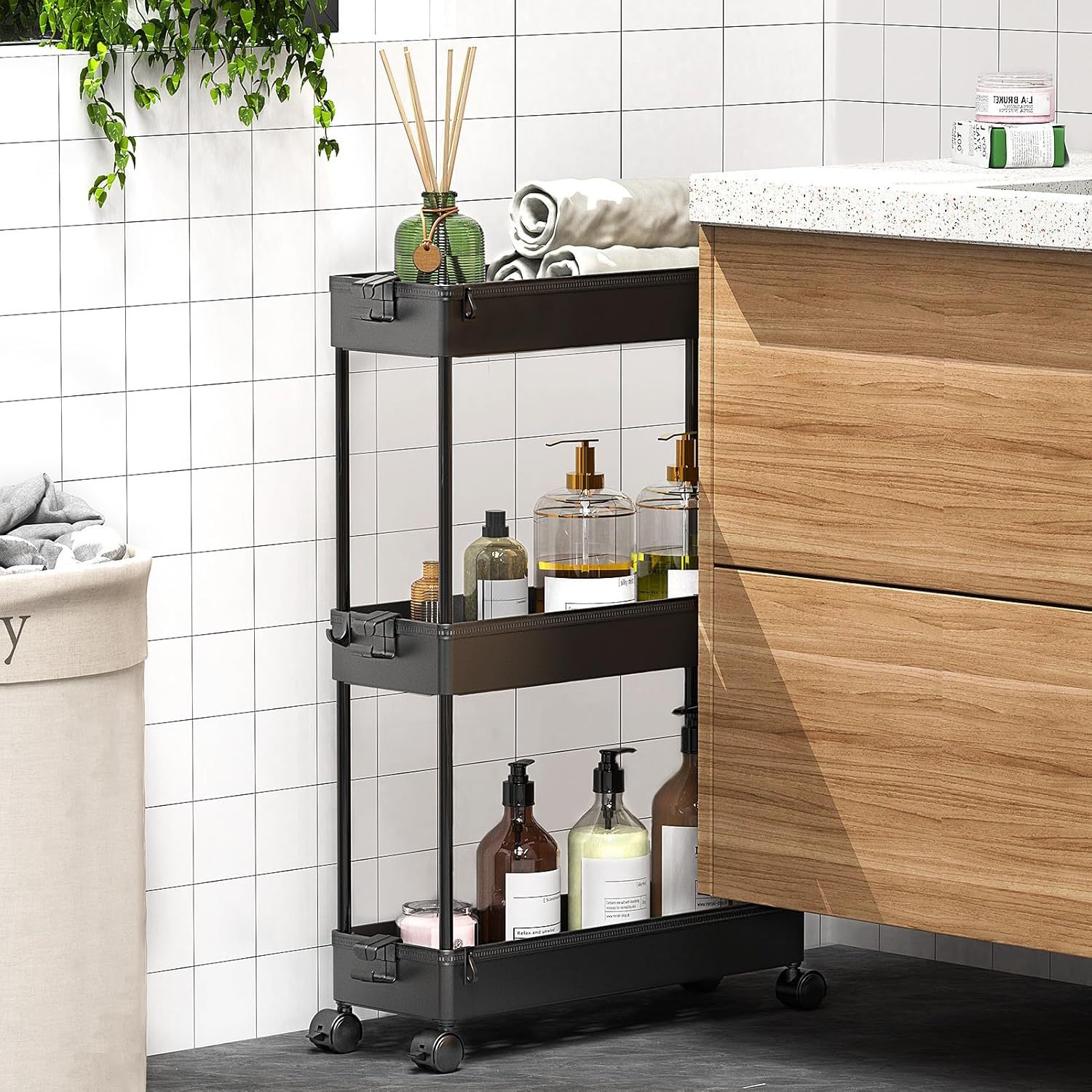
What it is: All-plastic kitchen carts - constructed from high-density polypropylene (PP) or ABS - offer a fundamentally different value proposition from metal alternatives. Completely rust-proof, chemically resistant, and significantly lighter than metal, plastic carts address a specific set of consumer needs that metal cannot serve equally well.
Commercial profile: All-plastic carts occupy the entry-level price segment and deliver the highest unit velocity within a retail range. Their accessibility makes them a strong impulse or add-on purchase, and their complete moisture resistance makes them particularly well-suited for consumers in high-humidity environments or those who store cleaning chemicals on or near the cart.
From a retail merchandising perspective, plastic carts are also the most practical format for markets where consumers prioritize low price over premium aesthetics - making them a reliable volume driver even in competitive retail environments.
Key specifications to evaluate:
- Plastic grade - food-safe PP is the benchmark for kitchen-use products; verify BPA-free compliance for markets with strict chemical regulations
- Surface texture - matte finishes photograph and display better than glossy alternatives, and show less wear over time
- Structural reinforcement - look for internal ribbing or cross-bracing in the shelf design to prevent flexing under load
- Caster integration - plastic casters are acceptable at this price point, but dual-locking capability should still be standard
Best for: Distributors supplying value retail channels, buyers entering the category at a low-risk price point, and retailers serving consumer segments where practicality and price outweigh design considerations.
Material 3: Metal + Acrylic Carts

What it is: Metal frame carts with acrylic (transparent plastic) shelving panels represent the design-forward end of the kitchen storage cart category. The combination of a structural metal frame - typically powder-coated steel in black or white - with clear acrylic shelves creates a visually lightweight product that does not visually dominate the kitchen space.
Commercial profile: Metal + acrylic carts serve a specific and growing consumer segment: buyers who want organized kitchen storage but are unwilling to accept a product that visually clutters their space. The transparency of acrylic shelving makes contents visible from all angles, reduces the visual bulk of the cart, and aligns with the "clean kitchen" aesthetic that has become a dominant design preference across multiple markets.
This material combination is particularly well-suited to smaller kitchens where visual lightness matters - the cart provides full storage functionality without making the space feel more cramped. For retailers, the distinctive visual profile of metal + acrylic carts creates strong shelf presence and differentiates clearly from standard all-metal or all-plastic alternatives.
Key specifications to evaluate:
- Acrylic thickness - minimum 4 – 5mm for kitchen use; thinner panels flex and crack under moderate loads
- Acrylic grade - UV-stabilized acrylic resists yellowing over time, a critical quality parameter for a product stored in a bright kitchen environment
- Frame-to-shelf connection - the joint between metal frame and acrylic shelf is the most common structural failure point; verify the connection method and test load tolerance
- Scratch resistance - acrylic scratches more easily than metal; surface hardness coating is a meaningful quality differentiator at this level
Best for: Retailers targeting design-conscious consumers, modern kitchen segments, and buyers looking to offer a visually distinctive product that commands a premium price without moving into the island cart segment.
Material 4: Metal + Fabric Carts

What it is: Metal frame carts with fabric basket or drawer inserts represent the softest, most interior-design-integrated option in the category. A powder-coated metal frame provides structure and stability, while fabric baskets - typically in canvas, non-woven material, or linen - create a warm, textured aesthetic that contrasts with the harder finishes dominant across the rest of the kitchen storage market.
Commercial profile: Metal + fabric carts occupy a distinctive position in the market: they appeal to consumers who prioritize aesthetic integration over absolute practicality. The soft textile inserts create a sense of warmth and intentionality that standard metal or plastic carts cannot replicate. In markets where consumers treat kitchen accessories as an extension of their interior design choices, fabric carts offer a genuine point of differentiation.
This material combination is also functionally well-suited to storing items that benefit from concealment - dry goods, reusable bags, kitchen linens - rather than items that need to be easily visible or accessible at all times. For retailers, this creates a natural cross-sell narrative with other textile-based home organization products.
Key specifications to evaluate:
- Fabric treatment - kitchen environments demand water-resistant or at minimum water-repellent fabric treatment; untreated natural fabrics are not suitable for kitchen use
- Fabric removability - removable and washable basket inserts are a meaningful functional feature that supports retail marketing and justifies a higher price point
- Frame stability - the metal frame carries the structural load; verify gauge and weld quality independently of the fabric component
- Color coordination - fabric color options should align with the wider color palette of your kitchen organization range to support cohesive retail merchandising
Best for: Retailers targeting home décor-oriented consumers, buyers building a soft, lifestyle-oriented kitchen range, and wholesale partners serving markets where interior design integration is a primary purchase driver.
Building Your Range: A Practical Framework
A well-structured kitchen storage cart range for most wholesale buyers should cover at least three of the four material categories
| Material | Price Tier | Primary Retail Positioning |
| All-Metal | Mid – Premium | Durability, quality, design |
| All-Plastic | Entry – Mid | Value, practicality, moisture resistance |
| Metal + Acrylic | Mid – Premium | Modern design, visual lightness |
| Metal + Fabric | Mid – Premium | Lifestyle, aesthetic integration |
Recommended starting structure for new buyers:
- All-Metal as your volume anchor - two colorways, two size variants
- All-Metal for the urban compact-living segment
- Metal + Acrylic or Metal + Fabric as your design-forward premium option
This structure gives your retail partners the ability to merchandise across multiple price points and consumer profiles without requiring an unmanageably large SKU count.
Working with a Manufacturing Partner Who Covers the Full Spectrum
For a product category with this level of material diversity, the capability of your manufacturing partner determines how complete and coherent your range can be.
At Wideny Organizer, we manufacture kitchen storage carts across all four material categories - with full OEM and ODM capability to develop custom colorways, dimensions, and fabric specifications for our wholesale partners. Our end-to-end service covers design consultation, prototyping, production, quality inspection, and export logistics - so your team manages the commercial relationship, not the supply chain complexity.
With a standard MOQ of 100 units per SKU and export experience spanning more than 100 countries including the US, Europe, South America, and the Middle East, we are structured to support wholesale buyers at every stage - from building an initial range to scaling established lines.
Browse our storage cart range and request wholesale pricing:
Full Kitchen Organizer Range →
Contact our wholesale team at https://www.widenyorganizer.com/contact-us