For wholesalers and distributors building out a kitchen organization range, dish racks are one of the most reliable volume drivers in the category. They are purchased repeatedly, used daily, and - when sourced correctly - carry strong retail margins with low return rates.
But buying dish racks in bulk is not simply a matter of choosing the cheapest price per unit. The material, configuration, finish, and manufacturing source all determine whether a product performs well at the retail level or sits in a warehouse. This guide breaks down everything professional buyers need to evaluate before placing a bulk order - written from the perspective of a home organizer manufacturer with export experience across more than 100 countries.
1. Material: The Decision That Defines Product Longevity
Material is the single most important specification in a dish rack. It determines rust resistance, weight, finish quality, and ultimately how long the product lasts in a customer's kitchen. For B2B buyers, this directly affects return rates, warranty claims, and brand reputation.

Stainless Steel
304 Stainless Steel: The industry benchmark for quality dish racks. Grade 304 offers superior corrosion resistance and is the standard expected by buyers in markets with high consumer quality awareness. It is heavier than alternatives but commands a premium retail price and carries strong perceived value. If you are targeting retailers who market on quality and durability, 304 stainless steel is the specification to insist on.
201 Stainless Steel: A more cost-effective alternative with lower rust resistance than 304. Suitable for entry-level retail price points where margin is the primary driver. However, in high-humidity environments - coastal climates, kitchens without ventilation - 201 is more prone to surface rust over time, which can generate after-sales issues.
Powder-Coated Carbon Steel
The most versatile option from a design standpoint. High-quality powder coating provides a durable protective layer and opens up a wide range of color options - Matte Black, Anthracite, Sand, Off-White - that align with current interior design trends. For retailers whose customers treat kitchen products as décor items, powder-coated racks offer the strongest visual differentiation on shelf.

What to ask your manufacturer:
- What steel grade is used - 304 or 201?
- What is the coating thickness for powder-coated products?
2. Configuration: Matching Product to Market Need
A dish rack is not a single product - it is a product category with meaningful variation in form and function. Understanding which configurations sell in your market is critical to building an inventory that moves.

2-Tier Racks
The volume leader across most retail channels. Two-tier designs maximize vertical space, allowing simultaneous drying of plates, bowls, mugs, and cutlery without increasing the countertop footprint. Strong sell-through in households with moderate kitchen size and regular cooking frequency.
Compact Single-Tier Racks
Essential for single-occupancy households, studio apartments, and minimalist-oriented consumers. Lower price point but high unit velocity in markets with large young-professional or student demographics.

Over-the-Sink Designs
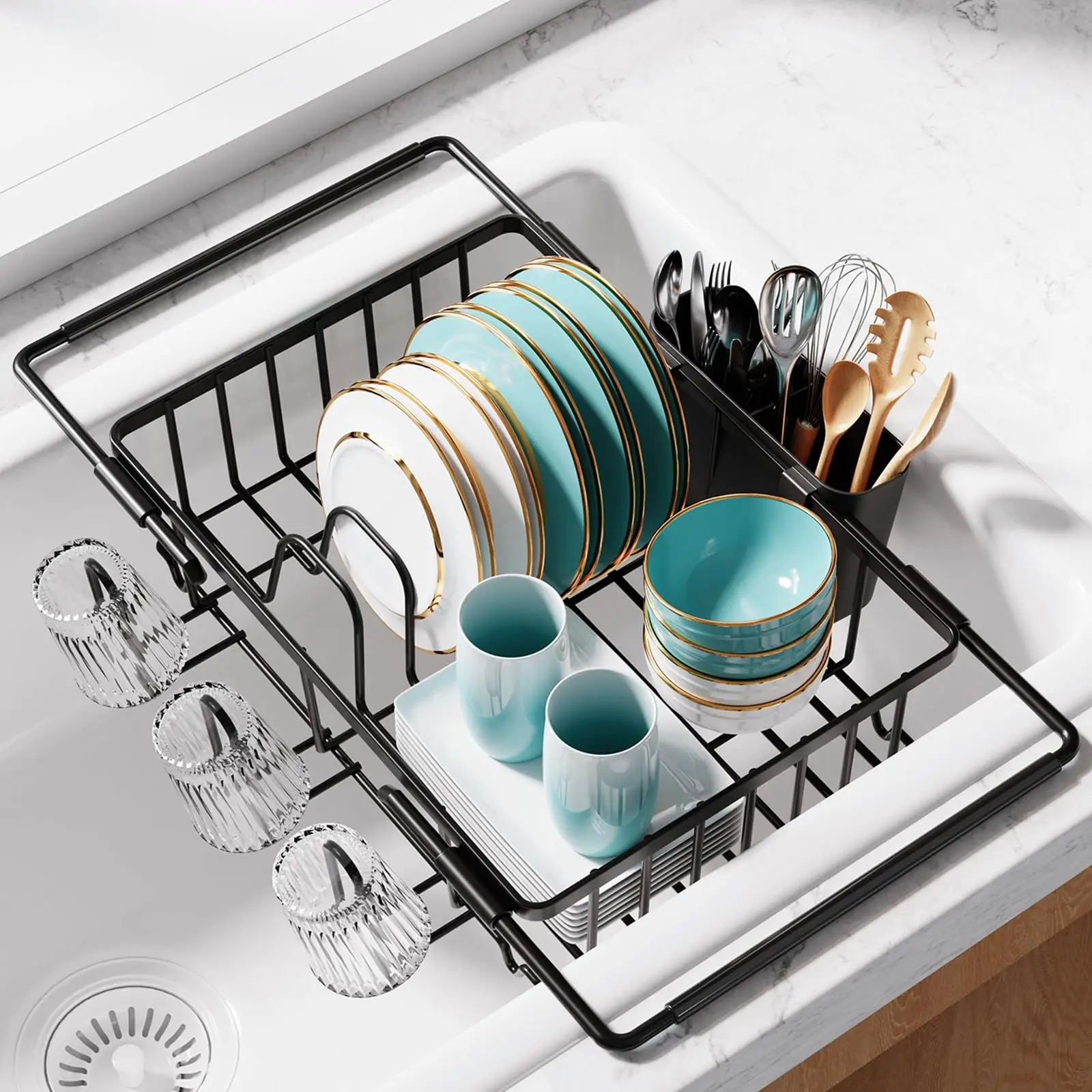
One of the fastest-growing configurations in the category. By positioning the rack directly over the sink, water drains immediately without pooling on the countertop - a key functional benefit for smaller kitchens. Retailers serving urban apartment markets consistently report strong demand for this format.
Modular and Expandable Systems
The premium end of the category. Racks with removable cutlery holders, adjustable drain spouts, and add-on components allow end-users to configure the product to their specific kitchen layout. These carry the strongest margins and the best potential for brand loyalty.

A well-structured dish rack range covers at least three of these four configurations - giving your retail partners the ability to merchandise across multiple price points and household types.
3. Design and Aesthetics: Why They Matter for B2B Buyers
The shift from purely functional to design-conscious kitchen products has been one of the most significant category changes of the past several years. For B2B buyers, this is not an abstract trend - it has direct implications for which products move off shelves and which do not.
Current design priorities across the retail market:
- Matte finishes over glossy surfaces - Matte Black in particular has become a dominant color direction in kitchen organizers across multiple markets
- Clean geometric lines with concealed or minimal drainage components - buyers are moving away from traditional exposed wire designs
- Neutral and earth-tone color palettes - Off-White, Sand, and Anthracite are performing strongly alongside classic Stainless Steel
- Cohesive product families - retailers increasingly want to merchandise dish racks alongside matching sponge holders, under-sink organizers, and other kitchen storage as a coordinated collection
For wholesalers, this means the visual identity of your dish rack range matters as much as the technical specification. Working with a manufacturer who offers custom color and finish options gives you the ability to build a differentiated range that cannot be directly price-compared on a marketplace.
4. Wideny Advantage: Why Sourcing Direct Matters
At Wideny Organizer, we are a home organization manufacturer. That means:
- Factory Pricing: Improves your unit economics and gives you more room to compete at the retail level.
- Low MOQ from 100 Units: Our standard MOQ for most dish rack lines starts at 100 units - significantly lower than the industry standard of 300 – 500 units. This allows you to trial new configurations or colorways with minimal inventory risk, which is particularly valuable when entering a new market or testing a new retail account.
- Full OEM & ODM Capability: Need your own branding? A custom color to match a retailer's house palette? A dimensional adjustment to fit a specific shelf space? Our in-house design and production teams handle all of these requirements directly.
- Export Experience Across 100+ Countries: We have shipped to wholesalers, distributors, and retail groups across North America,Europe, the Middle East, South America, and beyond. That experience translates into reliable documentation, compliant packaging, and logistics coordination to major ports worldwide.
5. Procurement Planning: Lead Times and Logistics
For buyers placing bulk orders, production and shipping timelines need to be built into your inventory planning cycle from the start.
Typical lead time breakdown:
- Pre-production and material sourcing: 3 – 7 days
- Production: 15 – 30 days depending on order volume and specification
- Quality inspection: 3 – 5 days
- Sea freight to major ports: 20 – 35 days
Total: approximately 45 – 80 days from order confirmation to warehouse arrival.
Seasonal planning guidance:
- For peak Q4 retail demand, place orders no later than July – August
- For spring/summer restocking, plan procurement in January – February
- Build in a 10 – 15 day buffer for customs clearance and unexpected delays
Explore Our Dish Rack Range
Our Kitchen Organizer collection covers the full spectrum of dish rack configurations and materials - designed for professional buyers who need consistent quality, and a manufacturing partner with the scale to support long-term growth.
Browse our dish rack range and request wholesale pricing:
Dish Rack Collection →
Full Kitchen Organizer Range →
Contact our B2B team at https://www.widenyorganizer.com/contact-us